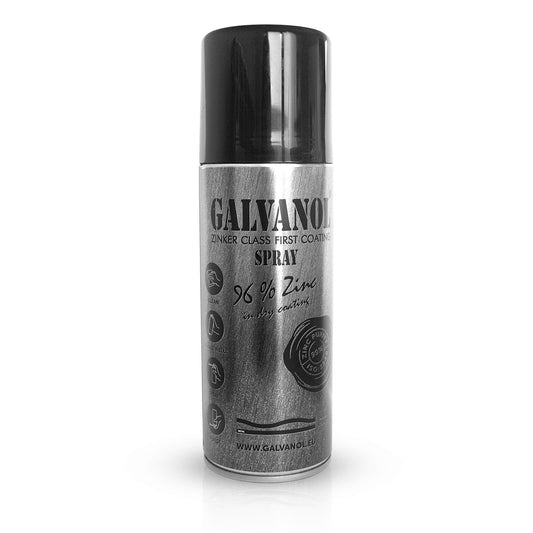
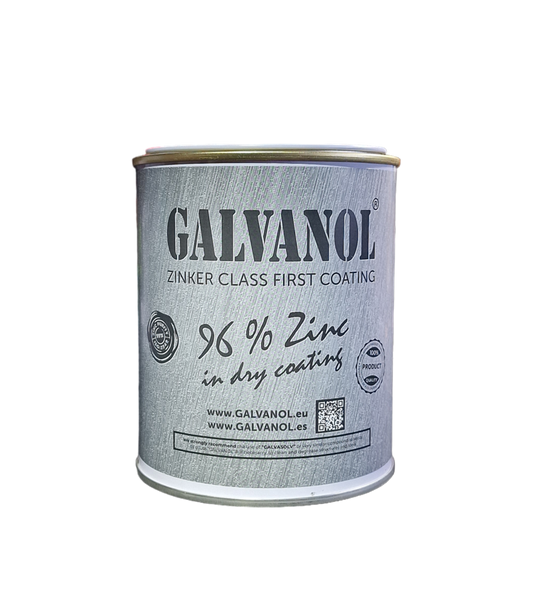
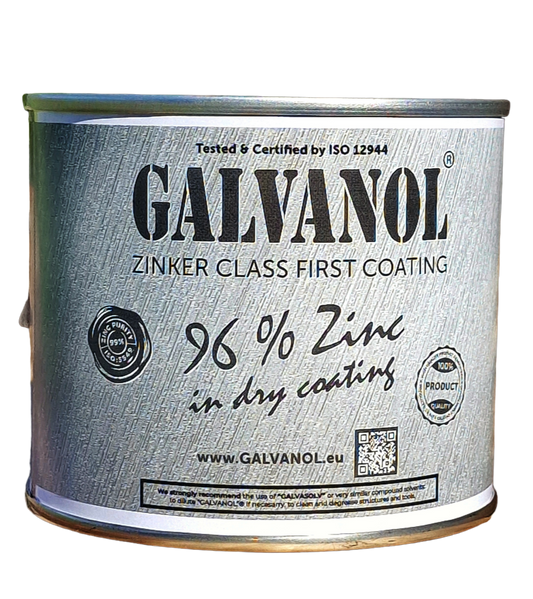
Minio, synthetic primer, "anti-rust" enamel... At the hardware store, it seems like everything protects against rust. But there is a fundamental difference between conventional anti-rust paint and a zinc-rich coating like GALVANOL, and that difference determines whether you will be repainting in two years or fifteen.
Passive protection: anti-rust paint
Conventional primer works like a raincoat: it isolates the steel from water and oxygen. As long as the film is intact, it protects. The problem arises with the first scratch, dent, or microcrack. That is how moisture gets in, rust spreads underneath the paint, and lifts it in blisters. That is why it is so common to see railings that look well painted and, when touched, flake off.
Active protection: cold galvanizing
GALVANOL contains 96% zinc in the dry film. Zinc is more "reactive" than iron, so when moisture is present, it sacrifices itself instead of the steel. This is called cathodic protection, and it is the same principle as hot-dip galvanizing. If the layer is scratched, the surrounding zinc continues to protect the bare steel in that area: rust does not spread underneath.
In addition, zinc also acts as a physical barrier, so you have both protections at once: active and passive.
Quick comparison
- If scratched: anti-rust paint lets rust through; cold galvanizing continues to protect.
- Durability: with the right thickness, GALVANOL reaches over 25 years in C3 and C4 environments according to the ISO 12944-6 tests in its technical data sheet.
- Galvanizing repair: anti-rust paint is not suitable for retouching hot-dip galvanizing; GALVANOL complies with ISO 1461 and ASTM A780 precisely for that.
- Finish: both accept topcoat paint over them (in the case of GALVANOL, solvent-based paints).
When does each one make sense?
Anti-rust primer may be suitable for indoor, dry, and decorative pieces. For anything outdoors, near the sea, in contact with moisture, in the field, or in industry, cold galvanizing is cheaper in the long run: you apply it once and forget about it for years.
What if it is already painted with anti-rust?
Zinc must be in direct contact with the steel to protect it. That is why, before applying GALVANOL, the old paint and loose rust must be removed. We explain it in our surface preparation guide.
Ready to protect your steel?
GALVANOL contains 96% zinc in the dry film, has laboratory tests accredited by ENAC according to ISO 12944, and complies with ISO 1461 and ASTM A780. We manufacture it in Spain and ship it in 24/72 h, free to the mainland and Balearic Islands from €50.
👉 GALVANOL 2 kg · GALVANOL Spray 500 ml · GALVANOL 2 kg application kit · How much GALVANOL do I need? calculator